The Unlikely Connection: Why Some Cheeses Smell Like Feet
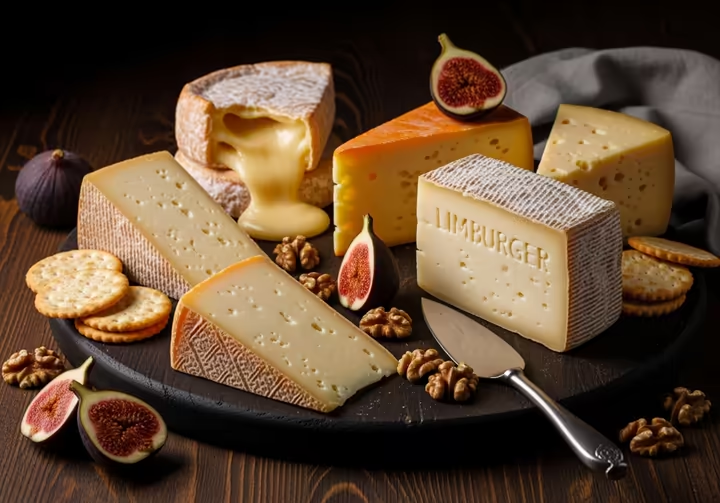
Ever opened a box of fancy cheese and thought, whoa, feet? That powerful, earthy, maybe even a little funky smell isn't a mistake. It's the secret sign of a surprisingly delicious experience.
But how can something that smells like a sweaty sock taste so good? The answer is all about a tiny, hard-working bacterium.
A Tale of Two Stinks
The Star of the Show: A Bacterium
That cheesy foot-smell isn't a coincidence. The main culprit is a bacterium called Brevibacterium linens . This little guy lives on human skin and is a major reason feet get stinky. 1
In a weird twist, B. linens is the same bacterium cheesemakers use on purpose. It creates the reddish rind and funky smell on washed-rind cheeses, like Limburger or Époisses. 3 It’s a living bridge between a sweaty sock and your cheese board.
A Perfect Home (for Bacteria)
B. linens loves warm, moist, salty places. Think: the space between your toes inside a shoe. 1 Cheesemakers copy this exact environment through a process called affinage (aging).
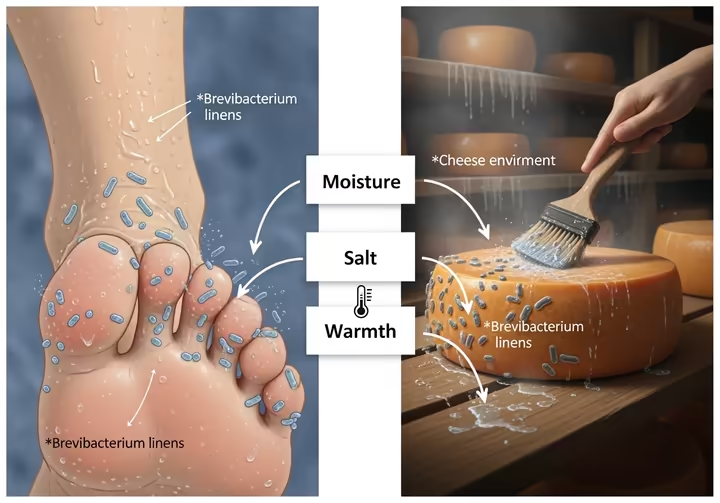
They repeatedly wash the cheese with a saltwater brine. This creates a perfect home for B. linens while kicking out other molds. 4 In both spots, on feet and on cheese, the bacteria eat nutrients and release smelly waste products.
The main one is isovaleric acid, the chemical that defines foot odor. 3 On feet, the bacteria get food (an amino acid called leucine) from sweat and dead skin cells. 1 On cheese, they get it from broken-down milk proteins. 11
Just Trying to Survive
Other bacteria, like Staphylococcus epidermidis , also help make isovaleric acid on feet. 8 Both environments can also produce sulfurous, "cheesy" smells from other compounds. 1
So why the smell? The bacteria make these stinky acids when they run out of easy-to-eat sugars and have to break down proteins for energy. 10 The stink is just their metabolic exhaust, a sign of them working hard to survive.
The Art of the Stink
The stink on a cheese is no accident, it's carefully crafted by a cheesemaker (or affineur ). This process of aging cheese is called affinage , and it's all about managing microbes. 7 For the smelliest cheeses, it all comes down to the washed rind.
Washed Rinds: How to Grow the Funk
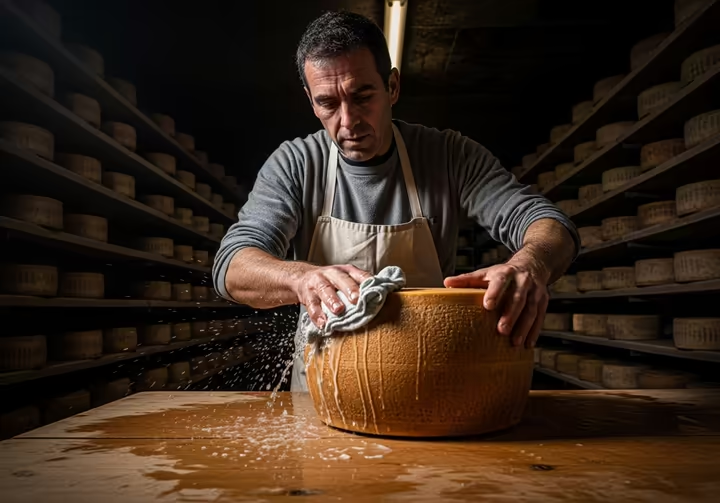
Washed-rind cheeses get their start after being pressed into a wheel. Then, they're repeatedly washed or smeared with a liquid solution over several weeks. 3
The wash, usually a saltwater brine, does two things. First, it kills off unwanted molds, like the white, fluffy stuff on Brie. 4 Second, the salty, wet surface is the perfect home for salt-loving bacteria, especially our friend B. linens . 4
This repeated washing ensures these "good" bacteria take over. They create that signature sticky, tacky texture and a pinkish-orange rind. 7 The cheesemaker is basically a microbe farmer, steering the cheese toward a very specific, funky goal.
Fueling the Funk: Breaking Down Protein
The cheesemaker sets the stage, but the cheese itself provides the food. The whole aging process relies on proteolysis, which is just a fancy word for proteins breaking down. 11
Enzymes from the milk and the rind's bacteria break down the cheese's internal structure (the "paste"). This breakdown from the outside-in is also why many washed-rind cheeses get so gooey and spoonable under the rind. 19
This process releases lots of free amino acids, including the leucine that B. linens turns into that stinky isovaleric acid. 12 More breakdown means more food for the bacteria, and more food means more funk.
A Field Guide to Famous Funk
The wash isn't always just brine. Cheesemakers sometimes add local booze to change the flavor and microbes. Here are a few famous stinkers.
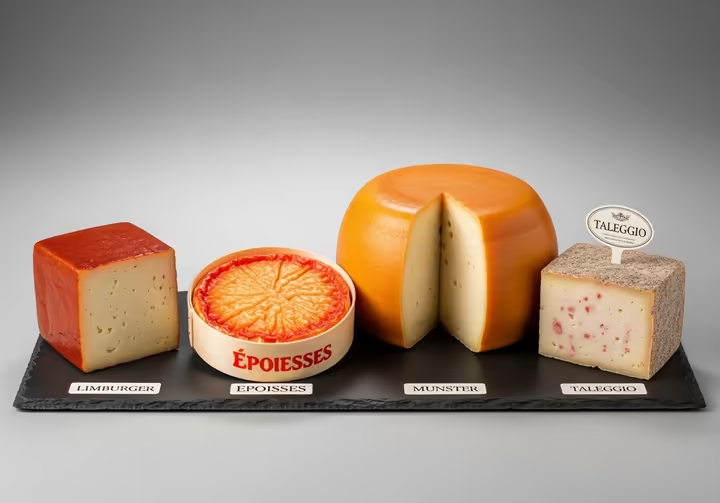
| Cheese Name | Origin | Washing Liquid | Aroma Profile | Contrasting Flavor Profile |
|---|---|---|---|---|
| Limburger | Belgium/Germany | Brine | Famously compared to sweaty feet; intensely pungent and earthy. 26 | Surprisingly mild; nutty, buttery, and sharp, especially when the rind is trimmed. 19 |
| Époisses de Bourgogne | Burgundy, France | Brine and Marc de Bourgogne (a local grape brandy). 28 | Powerfully meaty, "barnyardy," and pungent; famously banned on the Paris Metro. 26 | Rich, salty, and creamy with a distinctive fruity and savory balance. 28 |
| Munster d'Alsace | Alsace, France | Brine (rock salt and water). 33 | Strong "barnyard" aroma, reminiscent of a well-used stable; powerful and savory. 26 | Meaty and salty with a semi-soft, buttery texture; much milder than its aroma suggests. 26 |
| Taleggio | Lombardy, Italy | Brine | Described as wet grass, herbaceous, and having a body odor note that intensifies with age. 26 | Mild, fruity, and slightly tangy with a creamy texture; surprisingly delicate. 19 |
Good Funk vs. Bad Funk
For newcomers, telling a fancy stink from a spoiled stink can be tricky. But the aromas that cheese fans love are easy to spot once you know what to look for. "Spoilage" here is more of a spectrum than a simple yes or no.
The Sign of Overripeness: Ammonia
A good, stinky foot or barnyard smell is what you want. That's the sign of a happy, well-aged cheese. 5 But what about a sharp, chemical smell? That's ammonia, and it means the cheese is past its prime. 37
This isn't from bad germs. It happens when the good bacteria on the rind start to die off at the end of their life cycle, releasing ammonia as a final... gift. 37 It's a natural part of the process, which is basically the controlled spoilage of milk. 5
An ammoniated cheese isn't dangerous, but it won't taste great. If it's just a faint whiff, let the cheese sit out for 30-60 minutes to "breathe." 37 If the smell is strong and won't go away, it's best to toss it.
True Spoilage: When to Toss It
Overripe is one thing, but truly spoiled is another. Here’s when to say goodbye to your cheese.
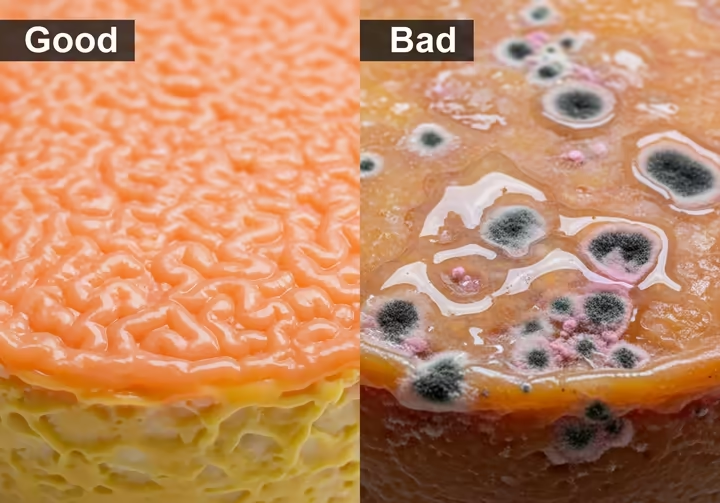
- Look at it: The rind should be orange-red and maybe a bit tacky, not slimy. 25 Watch out for fuzzy black or pink molds, that's a bad sign. 36
- Touch it: A slimy, wet rind is a no-go. That means unwanted yeasts or bacteria have crashed the party. 39 A cracked, dry rind can also be a gateway for spoilage. 36
- Smell it: Trust your nose. If it smells rancid, rotten, or like sour milk, it's bad. 39
- Taste it (maybe): When in doubt, a tiny taste tells all. If it's bitter, metallic, or unpleasantly sour, spit it out. 39
Training Your Brain to Love the Stink
The same molecule, isovaleric acid, can smell like gross feet OR delicious cheese. This proves we don't just smell with our nose, we smell with our brain. Liking stinky cheese is a victory of mind over matter.
Context is Everything
Your brain's perception of a smell is shaped by context and expectation. 40 The smell of vomit and Parmesan cheese share some key chemicals... the only difference is what you're looking at. 41
When you see cheese on a plate, your brain flips a "food" switch. It interprets the smell through a culinary lens, overriding your gut reaction to run away. 42 For a pro, years of good experiences have taught their brain that the funky smell signals a tasty, savory flavor is coming.
The Two Ways to Smell
The key to the stinky cheese paradox is understanding the two ways we smell.
- Orthonasal Olfaction: This is regular smelling. You sniff aromas from the air through your nostrils. This is your first impression of the stinky cheese on the cutting board. 43
- Retronasal Olfaction: This is the secret weapon. As you chew, smelly molecules from the food travel up the back of your throat into your nasal cavity. 43
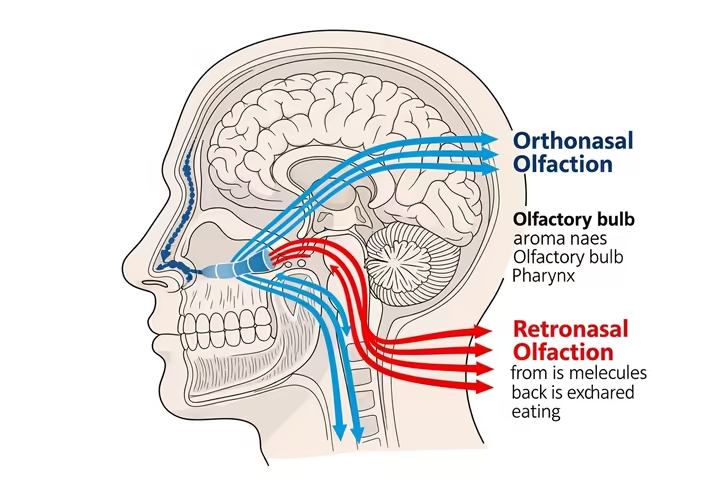
Almost everything we call "flavor" actually comes from this second, retronasal path. 43 Your tongue only gets five basic tastes (sweet, salty, etc.). It's the thousands of aromas you get retronasally that let you tell an apple from a pear, or a nutty Gruyère from a meaty Époisses. 47
This two-path system solves the puzzle. The first whiff (orthonasal) might be off-putting. But when you eat it, your brain combines that same smell (retronasal) with the nice feelings of saltiness and creaminess from your mouth. 42
Your brain bundles it all together into one delicious "flavor" package. 44 Through experience, you learn that the "dangerous" smell is actually a sign of good, rich food, which lights up your brain's pleasure circuits. 41
The Stinky Conclusion
So, that foot-smell from your fancy Limburger isn't a mistake. It's a signature from the same microbes that live on our skin, connecting our bodies to our food. 1 It's the result of cheesemakers carefully guiding a living ecosystem on the rind. 4
And it's proof that our brains can learn to love almost anything. We can transform a smell that screams "danger!" into a signal for "delicious!" 41 It shows that the world, and the food on our plates, is as interesting as we're willing to find it.
Works cited
- Brevibacterium linens – Knowledge and References - Taylor & Francis, https://taylorandfrancis.com/knowledge/Engineering_and_technology/Biomedical_engineering/Brevibacterium_linens/
- Brevibacterium linens - Wikipedia, https://en.wikipedia.org/wiki/Brevibacterium_linens
- Where does the odor of stinky cheese come from? And why does it smell like sweaty socks?! - American Chemical Society, https://www.acs.org/content/dam/acsorg/pressroom/reactions/infographics/odor-of-stinky-cheese.pdf
- The Wonderful World of Washed-Rind Cheeses - Falstaff, https://www.falstaff.com/en/news/the-wonderful-world-of-washed-rind-cheeses
- What Makes Stinky Cheese Stinky? | culture: the word on cheese, https://culturecheesemag.com/cheese-iq/ask-the-monger/makes-stinky-cheese-stinky/
- Spatial variations in the microbial community structure and diversity of the human foot is associated with the production of odorous volatiles | FEMS Microbiology Ecology | Oxford Academic, https://academic.oup.com/femsec/article/91/1/1/2467661
- The Magic of AFFINAGE - Cheese Connoisseur, https://www.cheeseconnoisseur.com/the-magic-of-affinage/
- Foot odor due to microbial metabolism and its control - Canadian Science Publishing, https://cdnsciencepub.com/doi/10.1139/w05-130
- Foot odor due to microbial metabolism and its control | Request PDF, https://www.researchgate.net/publication/7081113_Foot_odor_due_to_microbial_metabolism_and_its_control
- Fatty acid production from amino acids and alpha-keto acids by Brevibacterium linens BL2, https://pubmed.ncbi.nlm.nih.gov/15528496/
- Flavour formation by lactic acid bacteria and biochemical flavour profiling of cheese products | FEMS Microbiology Reviews | Oxford Academic, https://academic.oup.com/femsre/article/29/3/591/546865
- Biochemistry of Cheese Ripening: Proteolysis | Request PDF - ResearchGate, https://www.researchgate.net/publication/316908965_Biochemistry_of_Cheese_Ripening_Proteolysis
- Advances in the study of proteolysis during cheese ripening | Request PDF - ResearchGate, https://www.researchgate.net/publication/222323189_Advances_in_the_study_of_proteolysis_during_cheese_ripening
- 5-Methyl Furfural Reduces the Production of Malodors by Inhibiting Sodium l-Lactate Fermentation of Staphylococcus epidermidis - PubMed Central, https://pmc.ncbi.nlm.nih.gov/articles/PMC6723266/
- Staphylococcus epidermidis - Wikipedia, https://en.wikipedia.org/wiki/Staphylococcus_epidermidis
- Fatty Acid Production from Amino Acids and α-Keto Acids by ..., https://pmc.ncbi.nlm.nih.gov/articles/PMC525268/
- Affinage 101: Understanding the Aging of Cheese, https://www.cheeseprofessor.com/blog/affinage-101-aging-cheese
- The Art of Affinage | Wisconsin Cheese, https://www.wisconsincheese.com/the-cheese-life/article/167/art-of-affinage
- Stinky Cheese | Limburger, Taleggio & More - iGourmet, https://igourmet.com/blogs/gourmet-food-guide/stinky-cheese-cheese-guide
- The Microbial Diversity on the Surface of Smear-Ripened Cheeses and Its Impact on Cheese Quality and Safety - PMC, https://pmc.ncbi.nlm.nih.gov/articles/PMC10814198/
- FOOD FUN: Limburger Cheese & Other Washed Rind Cheeses, https://blog.thenibble.com/2020/07/22/food-fun-limburger-cheese-other-washed-rind-cheeses/
- Chemical methods for the characterization of proteolysis in cheese during ripening - Le Lait, https://lait.dairy-journal.org/articles/lait/pdf/1997/01/lait_77_1997_1_3.pdf
- Effect of ripening and in vitro digestion on free amino acids and Angiotensin I converting enzyme inhibitory (ACE-I) potential of cow and Buffalo milk cheddar cheeses, https://www.tandfonline.com/doi/full/10.1080/10942912.2022.2070200
- Impact of Natural Cheese Composition on Proteolysis and its Effects on Process Cheese Functionality - Open PRAIRIE - South Dakota State University, https://openprairie.sdstate.edu/cgi/viewcontent.cgi?article=1341&context=etd2
- For The Gooiest Cheeses, It's All About The Washed Rind - Daily Meal, https://www.thedailymeal.com/1154616/for-the-gooiest-cheeses-its-all-about-the-washed-rind/
- Top 5 Stinkiest Cheeses | HowStuffWorks, https://recipes.howstuffworks.com/dairy/5-stinkiest-cheeses.htm
- The Top 10 Stinkiest Cheeses in the World - Plyvine Catering, https://plyvinecatering.co.uk/the-top-10-stinkiest-cheeses-in-the-world/
- Époisses vs Taleggio: What's the Difference? - AnyCheese, https://anycheese.com/types/epoisses-vs-taleggio/
- Discover Époisses: The Cheese with an Unmatched Character - La Fromagerie Germain, https://www.fromagerie-germain.com/en/our-cheeses/lepoisses-aop/
- Epoisses Cheese - The Reluctant Gourmet, https://www.reluctantgourmet.com/epoisses-cheese/
- Epoisses – a soft, pungent, meaty, salty cheese, https://www.murrayscheese.com/dp/epoisses
- Germain Epoisses Cheese - Gourmet Dash, https://www.gourmetdash.com/epoisses-cheese-50640-config
- ARCHAEOLOGY OF CHEESE - Munster d'Alsace - Chef's Mandala, https://chefsmandala.com/archaeology-cheese-munster-dalsace/
- Munster DOP d'Alsace Cheese - iGourmet, https://igourmet.com/products/munster-dalsace-cheese
- Munster cheese - Wikipedia, https://en.wikipedia.org/wiki/Munster_cheese
- Shelf Life: A Key Component to Cheese - Shislers Cheese House, https://www.cheesehouse.com/cheese/shelf-life-a-key-component-to-cheese/
- Is this safe to eat ? : r/Cheese - Reddit, https://www.reddit.com/r/Cheese/comments/16m4wxr/is_this_safe_to_eat/
- Why is runny Brie so good but the rind so bad? : r/Cheese - Reddit, https://www.reddit.com/r/Cheese/comments/7c4ih2/why_is_runny_brie_so_good_but_the_rind_so_bad/
- How to Tell If Cheese Is Bad (Or Just Aging Naturally) - Secret Lands Farm, https://www.secretlands.ca/uncategorized/how-to-tell-if-cheese-is-bad-or-just-naturally-aging/
- The Psychology of Flavor: How Perception and Memory Influence ..., https://aromatechgroup.com/actus-business-units/the-psychology-of-flavor-how-perception-and-memory-influence-taste/
- What Stinky Cheese Tells Us About the Science of Disgust, https://www.smithsonianmag.com/science-nature/what-stinky-cheese-tells-us-about-disgust-180965017/
- MECHANISMS OF FLAVOR PERCEPTION - HOW ODOR AND TASTE INTERACT WHEN WE EAT - KI Open Archive, https://openarchive.ki.se/articles/thesis/Mechanisms_of_flavor_perception_how_odor_and_taste_interact_when_we_eat/26923024/1/files/48968515.pdf
- Retronasal smell - Wikipedia, https://en.wikipedia.org/wiki/Retronasal_smell
- The Effect of Retronasal Odor Adaptation on Flavor Perception - TRACE: Tennessee Research and Creative Exchange, https://trace.tennessee.edu/cgi/viewcontent.cgi?article=3098&context=utk_chanhonoproj
- Sense of smell - Wikipedia, https://en.wikipedia.org/wiki/Sense_of_smell
- Retronasal Olfaction in Chronic Rhinosinusitis - PMC, https://pmc.ncbi.nlm.nih.gov/articles/PMC6179958/
- Cheese Expert Tastes the World's Stinkiest Cheeses - video Dailymotion, https://www.dailymotion.com/video/x9nvhk2
- Inter-individual retronasal aroma release variability during cheese consumption: Role of food oral processing | Request PDF - ResearchGate, https://www.researchgate.net/publication/274618746_Inter-individual_retronasal_aroma_release_variability_during_cheese_consumption_Role_of_food_oral_processing
- Transfer of Odor Perception From the Retronasal to the Orthonasal Pathway - PMC - PubMed Central, https://pmc.ncbi.nlm.nih.gov/articles/PMC7909302/
- Food-Related Odors Activate Dopaminergic Brain Areas - Frontiers, https://www.frontiersin.org/journals/human-neuroscience/articles/10.3389/fnhum.2017.00625/full
- Value Disgust: Appreciating Stench's Role in Attention, Retention and Deception, https://journals.openedition.org/estetica/8586