That Bush Smells Like Cat Pee (And Why It's Supposed To)
Notice a weird smell in your garden? Ahem... like cat pee? You sniff around, but there's no cat in sight. You're not imagining things, and your neighbor's cat probably isn't to blame.
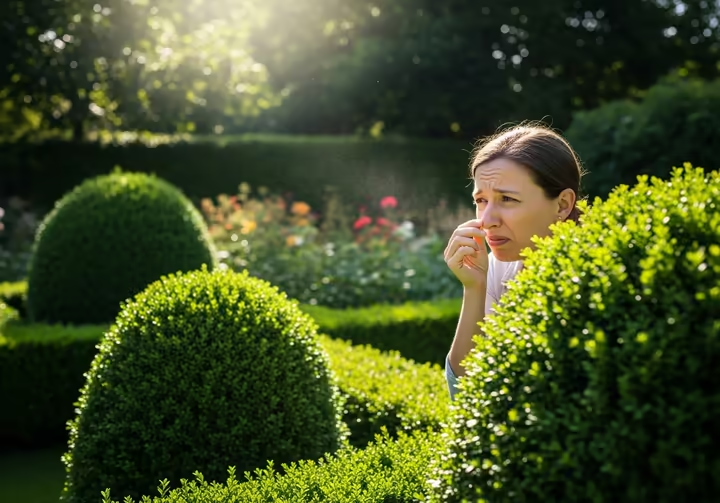
The culprit might be one of your plants. That strange, out-of-place aroma is actually a chemical message from the plant world. It’s a story of self-defense, weird coincidences, and why our brains get so easily fooled.
Meet the Main Suspect: Boxwood
In the lineup of smelly plants, one shrub is the usual suspect, the Boxwood. It’s a super common evergreen with dense, green leaves. People love it because it can be trimmed into neat hedges, fancy borders, or even animal shapes.
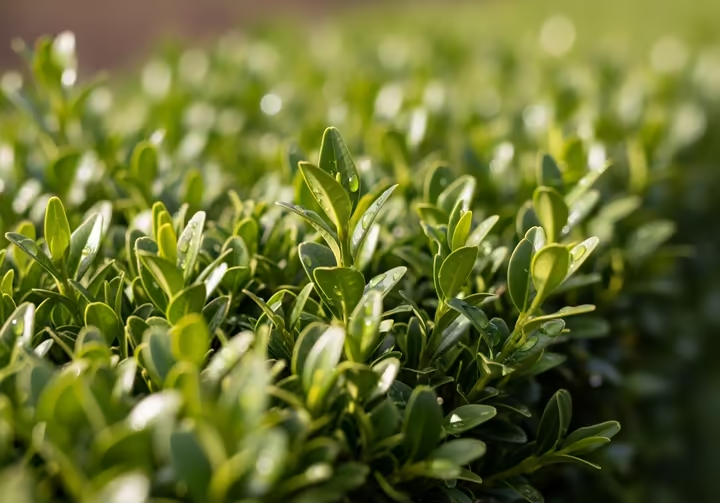
But some types of Boxwood have a stinky secret. The worst offender is usually the English Boxwood ( Buxus sempervirens ). On warm, sunny days, the heat releases oils from the leaves, and... hello, cat pee smell.
We’ve actually made the problem worse. By planting rows of them right next to our windows and patios, we’ve created a concentrated cloud of stink. In the wild, one bush’s smell would just fade away on the breeze.
Not All Boxwoods Stink
Interestingly, not all of them are smelly. Asian varieties, like Buxus microphylla ('Winter Gem' or 'Wintergreen'), have little to no odor. Breeders have even created popular hybrids that mix the classic English look with the less offensive Asian smell.
Plus, not everyone even notices it. Some people can’t detect the smell at all, while others find it kind of pleasant. It all depends on your nose and your memories.
The Science Bit: What's in a Stink?
To solve this mystery, we need to talk about molecules. The smell comes from a type of chemical called a thiol. Thiols have sulfur in them, and the human nose is REALLY good at detecting sulfur, even in tiny amounts.
This is why thiols are behind some of the world's most powerful smells. Think skunk spray, garlic, or the rotten-egg smell they add to natural gas to warn you of a leak.
Molecular Twins
So here’s the big reveal. Scientists looked at the smelly air coming off a Boxwood bush and found a chemical called 4-methyl-4-mercaptopentan-2-one . In the perfume industry, they just call it "cat ketone."
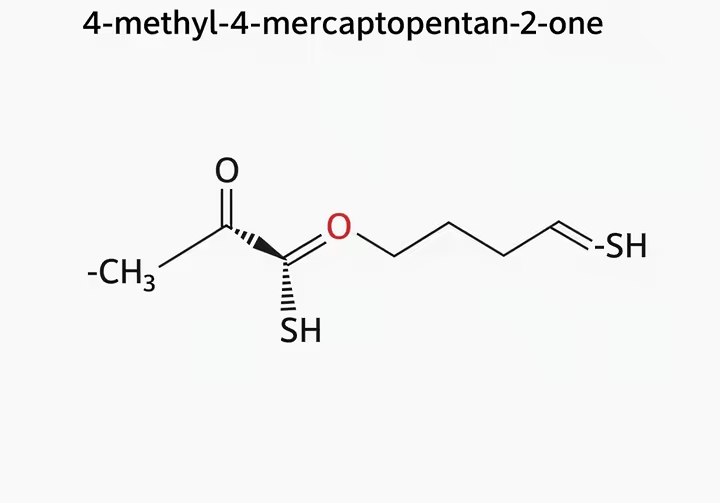
That’s because it's one of the exact same chemicals found in actual cat pee. The plant and the cat make the same stinky molecule through totally different processes. Your nose can’t tell the difference, so your brain just thinks, "CAT!"
It's All About Context
But here’s where it gets really weird. That same "cat ketone" chemical is also a key ingredient in the taste of blackcurrants. It’s also considered a good thing in fancy wines, especially Sauvignon Blanc.
In a wine glass, surrounded by other fruity smells, our brain translates that thiol into an elegant note of "cassis" or "gooseberry." In a hedge, it's just cat pee. Same chemical, different story. It shows we smell with our brains, not just our noses.
So... Why Does It Smell So Bad?
A plant doesn't smell this strong by accident. It’s a feature, not a bug. The main theory is that the smell is a form of chemical warfare.
A 'Do Not Eat' Sign
Plants can’t run away from hungry animals, so they have to get creative with self-defense. The Boxwood's pungent smell is a big, stinky 'KEEP OUT' sign for grazers like deer and rabbits.
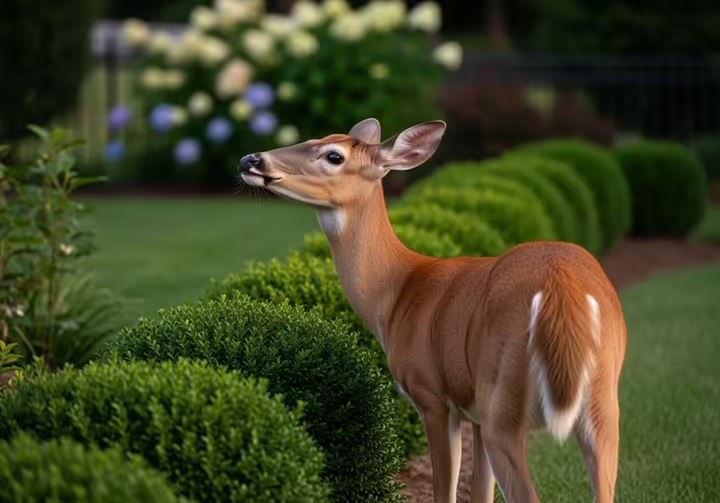
And it’s not a bluff. Boxwood leaves contain bitter chemicals that can make an animal sick if they eat them. The smell is a warning that saves the plant from getting chomped on in the first place.
Calling for Backup
The smell might be even cleverer than that. Sometimes, when a plant is being eaten by insects, its smell acts as a chemical 'cry for help.' It can attract predatory bugs, like wasps, that then attack the insects eating the plant.
The smell can also act as a warning to other nearby plants. When healthy plants 'smell' a damaged neighbor, they start ramping up their own defenses, just in case. It’s a neighborhood watch system for plants.
Other Stinky Suspects
Boxwood may be the most famous, but it’s not the only plant with a "catty" smell. Valerian, an herb used in sleep remedies, has roots that give off a funky odor often compared to dirty socks or... yup, pee.
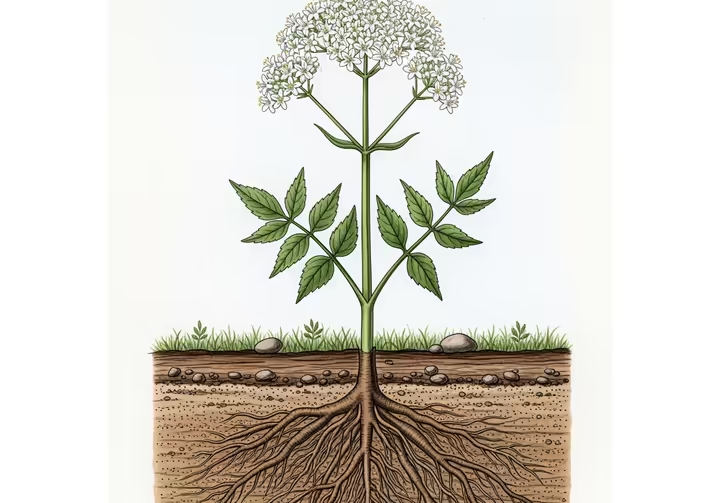
But unlike Boxwood, cats LOVE the smell of Valerian. It contains a chemical that acts like a cat pheromone, making them feel euphoric and excited, similar to catnip. Two "urine-like" smells, two totally different messages for cats.
And don't forget the Blackcurrant bush. It has the same "cat ketone" as Boxwood, which is why some wine experts playfully describe the taste of Sauvignon Blanc as "cat's pee on a gooseberry bush." (They mean it as a compliment, honest!)
How to Deal With the Smell
Okay, the science is cool, but you probably still don't want your garden to smell like a giant litter box. Luckily, you have options.
Plant Smarter
Since the smell is strongest in the sun, the easiest fix is placement. Plant smelly Boxwoods away from your windows, front door, and patio. Give the scent some space to fade before it reaches your nose.
Some gardeners also say that trimming the bushes right before their tiny flowers bloom in spring can help. Better airflow from thinning out the branches might also disperse the smell faster.
Smell-Free Alternatives
If you can't stand the scent, there are great lookalikes. Japanese Holly ( Ilex crenata ) has small, glossy leaves and can be shaped just like a Boxwood, but with zero catty odor.
Other good options are certain types of Inkberry Holly ( Ilex glabra ), like 'Gem Box' or 'Strongbox'. They’ve been bred specifically to have that compact, Boxwood-like shape.
Or... you could just learn to appreciate it. Instead of a flaw, you can see the smell for what it is, a sign of a healthy plant defending itself. It's the powerful, unfiltered scent of survival happening right in your backyard.
Works cited
- Boxwoods? Bah! - GardenRant, https://gardenrant.com/2014/05/boxwoods-bah.html
- What is this hedge-y thing that smells like cat pee? Portland, Or. : r/whatsthisplant - Reddit, https://www.reddit.com/r/whatsthisplant/comments/16teuku/what_is_this_hedgey_thing_that_smells_like_cat/
- How Do I Get Rid Of These Smells? - The Well Trained Mind Forum, https://forums.welltrainedmind.com/topic/410264-how-do-i-get-rid-of-these-smells/
- Beware of Boxwoods - Garden Musings - Blogger.com, https://kansasgardenmusings.blogspot.com/2014/05/beware-of-boxwoods.html
- What is this shrub : r/landscaping - Reddit, https://www.reddit.com/r/landscaping/comments/13lvx17/what_is_this_shrub/
- How to Grow Beautiful Boxwood Shrubs | Garden Design, https://www.gardendesign.com/shrubs/boxwood.html
- FPS80/FP080: Buxus sempervirens Common Boxwood - UF/IFAS EDIS, https://edis.ifas.ufl.edu/publication/FP080
- Selecting Landscape Plants: Boxwoods | VCE Publications - Virginia Tech, https://www.pubs.ext.vt.edu/426/426-603/426-603.html
- Tips & Information about Boxwoods | Gardening Know How, https://www.gardeningknowhow.com/ornamental/shrubs/boxwood
- Boxwood – Variety Without Odor | Walter Reeves: The Georgia ..., https://www.walterreeves.com/landscaping/boxwood-variety-without-odor/
- Pests, Diseases and Problems - NewGen® Boxwood, https://www.newgenboxwood.com/whats-wrong-with-my-boxwood
- Boxwood odor - Powered by ... - Sciencemadness Discussion Board, http://www.sciencemadness.org/talk/viewthread.php?tid=65586
- Stinky boxwoods - Houzz, https://www.houzz.com/discussions/1593836/stinky-boxwoods
- The Scent of Boxwoods, https://thescentofboxwoods.com/2020/10/15/the-scent-of-boxwoods/
- Buxus sempervirens (common boxwood) | CABI Compendium, https://www.cabidigitallibrary.org/doi/full/10.1079/cabicompendium.10484
- Buxus sempervirens - Wikipedia, https://en.wikipedia.org/wiki/Buxus_sempervirens
- boxwood bushes odor #853773 - Ask Extension, https://ask.extension.org/kb/faq.php?id=853773
- Boxwood shrub can stink up your Sale - Crossland Real Estate - Austin TX, https://crosslandteam.com/blog/2006/04/04/boxwood-shrub-can-stink-up-your-sale/
- p-mentha-8-thiol-3-one - cfsanappsexternal.fda.gov, https://hfpappexternal.fda.gov/scripts/fdcc/index.cfm?set=FoodSubstances&id=MENTHATHIOLONE
- p-Mentha-8-thiol-3-one | C10H18OS | CID 61982 - PubChem, https://pubchem.ncbi.nlm.nih.gov/compound/p-Mentha-8-thiol-3-one
- 4-Mercapto-4-methylpentan-2-one | C6H12OS | CID 88290 - PubChem, https://pubchem.ncbi.nlm.nih.gov/compound/88290
- www.compoundchem.com, http://www.compoundchem.com/wp-content/uploads/2015/07/The-Chemistry-of-Blackcurrants.pdf
- Showing metabocard for 4-Mercapto-4-methyl-2-pentanone (HMDB0031519) - Human Metabolome Database, https://hmdb.ca/metabolites/HMDB0031519
- Aroma and Sensory Profiles of Sauvignon Blanc Wines from Commercially Produced Free Run and Pressed Juices - AGRIS, https://agris.fao.org/search/en/providers/122535/records/65df61df63b8185d9cac9fae
- NATURAL 3-MERCAPTOHEXYL ACETATE | Axxence Aromatic GmbH, https://www.axxence.de/en/products/natural-3-mercaptohexyl-acetate-385120.html
- Felinine - Wikipedia, https://en.wikipedia.org/wiki/Felinine
- The chemistry of cats: Allergies, catnip and urine - Compound Interest, https://www.compoundchem.com/2020/07/07/the-chemistry-of-cats-allergies-catnip-and-urine/
- Semiochemicals from Domestic Cat Urine and Feces Reduce Use of Scratching Surfaces, https://pmc.ncbi.nlm.nih.gov/articles/PMC10854617/
- Black Currant Sprouts aroma – TasterPlace, https://tasterplace.shop/blogs/news/black-currant-sprouts-aroma
- On Cats & Cassis - SmellyBlog, http://ayalasmellyblog.blogspot.com/2018/06/on-cats-cassis.html
- Fiano, Greco and Falanghina grape cultivars differentiation by volatiles fingerprinting, a case study - PMC, https://pmc.ncbi.nlm.nih.gov/articles/PMC6716974/
- Cat's pee – Tim Atkin – Master of Wine, https://timatkin.com/cork-talk/cats-pee/
- Plant defense against herbivory - Wikipedia, https://en.wikipedia.org/wiki/Plant_defense_against_herbivory
- Mechanisms of plant defense against insect herbivores - PMC - PubMed Central, https://pmc.ncbi.nlm.nih.gov/articles/PMC3493419/
- Protective perfumes: the role of vegetative volatiles in plant defense against herbivores - PubMed, https://pubmed.ncbi.nlm.nih.gov/19467919/
- Secondary Metabolites: Definition, Classes, and Functions (Part-1) - Plant Cell Technology, https://plantcelltechnology.com/blogs/blog/blog-secondary-metabolites-definition-classes-and-functions-part1
- Start with Deer-Resistant Shrubs - Pasquesi Home and Gardens, https://pasquesi.com/start-with-deer-resistant-shrubs/
- Cyclobuxine - Wikipedia, https://en.wikipedia.org/wiki/Cyclobuxine
- Pest Control: Hiding in plain smell - eLife, https://elifesciences.org/articles/60912
- Plant Volatile Organic Compounds: Revealing the Hidden Interactions - PMC, https://pmc.ncbi.nlm.nih.gov/articles/PMC11859731/
- 'Scents' of alarm: Volatile chemical signals from damaged plants warn neighbors about herbivore attacks | ScienceDaily, https://www.sciencedaily.com/releases/2022/03/220310115124.htm
- Valerian - Advice From The Herb Lady, https://advicefromtheherblady.com/plant-profiles/perennials/valerian/
- Root Scent Composition in Valeriana officinalis and Valeriana edulis ssp. procera Analyzed by HS-SPME-GC-MS a. - ResearchGate, https://www.researchgate.net/publication/311732244_Root_Scent_Composition_in_Valeriana_officinalis_and_Valeriana_edulis_ssp_procera_Analyzed_by_HS-SPME-GC-MS_a
- Valerian (herb) - Wikipedia, https://en.wikipedia.org/wiki/Valerian_(herb)
- (PDF) Biomedically relevant chemical constituents of Valeriana officinalis - ResearchGate, https://www.researchgate.net/publication/274411047_Biomedically_relevant_chemical_constituents_of_Valeriana_officinalis
- en.wikipedia.org, https://en.wikipedia.org/wiki/Valerian_(herb)#:~:text=Valerian%20root%20is%20a%20cat,which%20can%20affect%20cat%20behavior.
- Behavioral differences among domestic cats in the response to cat-attracting plants and their volatile compounds reveal a potential distinct mechanism of action for actinidine, https://pmc.ncbi.nlm.nih.gov/articles/PMC9414117/
- Compounds identified in catnip and silver vine known or believed to have a stimulating effect on cats - ResearchGate, https://www.researchgate.net/figure/Compounds-identified-in-catnip-and-silver-vine-known-or-believed-to-have-a-stimulating_fig1_315113929
- Everything You Need To Know About Valerian Root | Munchiecat, https://www.munchiecat.com/blogs/cat-behavior/valerian-root
- Valerian for cats - sedative and toy? | Cat's Best, https://www.catsbest.eu/valerian-for-cats-sedative-and-toy/
- Ultra Blend - Catnip, Silvervine and Valerian Blend | Meowy Janes, https://meowyjanes.com/products/meowy-janes-ultra-blend/
- Sauvignon Blanc- not just cat pee - Carmenere, and Malbec - WSET Class #4 - Part 1, https://www.wineandthensommwinetours.com/blog/2017/05/sauvignon-blanc-not-just-cat-pee.html
- www.gardeningknowhow.com, https://www.gardeningknowhow.com/ornamental/shrubs/boxwood/boxwood-has-bad-odor.htm#:~:text=If%20you%20are%20concerned%20about,used%20areas%20of%20your%20landscape.&text=Consider%20using%20Little%20Leaf%20boxwood,in%20zones%206%20through%209.
- Trimming Boxwoods: 3 Reasons to Trim Boxwoods - 2025 - MasterClass, https://www.masterclass.com/articles/trimming-boxwoods-explained
- Tips on Pruning Boxwood, https://www.newgenboxwood.com/blog/2020/3/3/pruning
- 8 Practical Alternatives to Boxwood Shrubs | Proven Winners, https://www.provenwinners.com/learn/top-ten-lists/8-practical-alternatives-boxwood-shrubs
- Is it true that boxwood should be avoided? I'm in us zone 6 : r/Horticulture - Reddit, https://www.reddit.com/r/Horticulture/comments/1k2u1jy/is_it_true_that_boxwood_should_be_avoided_im_in/
- Boxwood Alternatives Program - Spring Meadow Nursery, https://springmeadownursery.com/plant_programs/boxwood-alternatives-program
- The Latest Set of Boxwood Alternatives - YouTube, https://www.youtube.com/watch?v=QZvIpJLCRC4