What Smells Do Dogs Hate? (And Why)
A dog's nose is basically a superpower. It’s how they see the world. So when they hate a smell, they really hate it. Let's find out what smells make your dog run for the hills, and why.

A Dog's Super-Sniffer
To understand why a dog hates certain smells, you first have to appreciate their nose. Saying a dog's sense of smell is "better" than ours is like saying a fighter jet is "faster" than a bicycle. It's a completely different league.
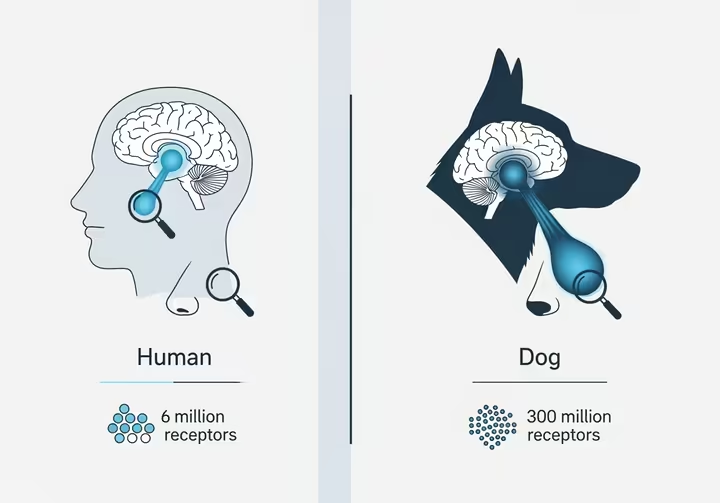
Let's talk numbers. You have about 6 million smell receptors in your nose. A dog? Up to 300 million. 1 If you flattened out your smell-detecting surface, it'd be the size of a postage stamp. A dog's would be the size of a handkerchief. 1
This means a trained dog can detect a single drop of a substance in 20 Olympic-sized swimming pools. 2 That's some serious sniffing power.
Built for Smelling
A dog's nose is also a feat of engineering. When you inhale, air for breathing and smelling goes through the same pipe. When a dog inhales, a little flap of tissue separates the air into two paths, one for breathing and one just for smelling. 3
Better yet, when a dog exhales, the air shoots out through slits on the sides of their nostrils. This pushes old air out while helping to pull new smells in. They can sniff continuously, gathering more and more information with every breath. 2
A Second, Secret Nose
And wait, there's more. Dogs have a second, secret smell system called the vomeronasal organ, or Jacobson's organ. 6 It's a little pouch in the roof of the mouth that's designed to detect big molecules like pheromones, which are chemicals that carry social information. 12
This organ sends signals straight to the brain's ancient centers for emotion and instinct. 13 This is a primal, hardwired channel for scent that can trigger immediate behavioral changes, no thinking required.
A World of Smell-o-Vision
All this nose-hardware needs a big computer to run it. The part of a dog's brain for analyzing smells is about 40 times bigger than yours. 2 Some scientists think up to a third of a dog's brain is dedicated to olfaction. 1
Neuroscientists recently discovered a massive neural highway connecting the dog's smell-processing center directly to its vision-processing center. 16 This link, not found in any other species, suggests that for a dog, smelling and seeing are deeply connected. They might perceive a unified "smell-picture" of the world, where a strong, irritating smell doesn't just stink, it corrupts their entire reality.
Why Dogs Hate Certain Smells
So why do they hate some smells? It's not just them being picky. It boils down to three things, the smell is too strong, it physically hurts, or it signals danger.
Sensory Overload
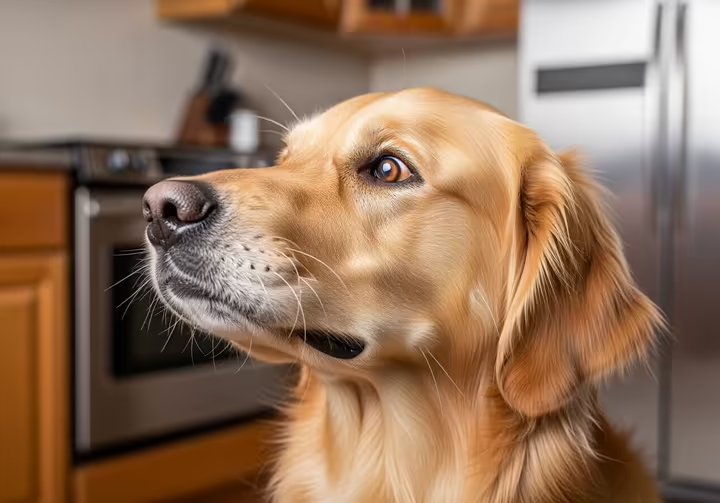
That super-sniffer is a double-edged sword. A nice floral scent to you can be like a rock concert in their nose. 18 When their olfactory system gets bombarded with too many scent molecules, it can cause real physiological stress. The experience is like being trapped in a small room with a blaring siren, it's physically and mentally exhausting. 18
It Actually Hurts
Some smells don't just overwhelm, they actually cause pain. Think chili peppers. The spicy compound, capsaicin, triggers the same pain receptors in a dog's nose and throat that tell our brain "this is hot!". 22 The smell is a direct warning signal for pain.
Many household cleaners do the same thing. Chemicals like ammonia and chlorine bleach are harsh irritants that can cause chemical burns to their nasal passages and lungs. 24 A dog's instinct to run away is a smart self-preservation move.
Instinct and Bad Memories
Dogs are born knowing some things are bad news. A bitter, poison-y smell is a built-in "stay away" signal from their ancestors. 28 But they also learn from experience. If the antiseptic smell of a vet's office always means getting a shot, they'll quickly learn to hate that smell. 29
This explains why dogs gleefully roll in things we find disgusting. To them, poop and decay are just social media updates full of juicy info about other animals. 31 Our "clean" smells like bleach and strong citrus? To a dog's nose, that smells like an unnatural and dangerous chemical attack.
The Hit List: Smells Dogs Can't Stand
Pungent Natural Scents
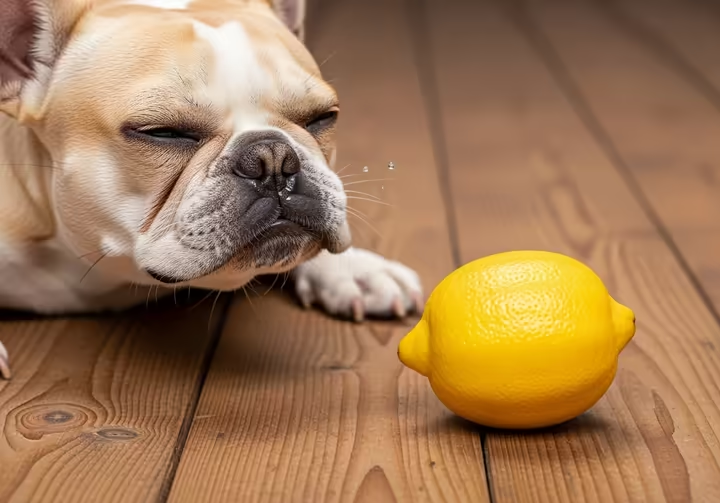
Citrus: This is a classic. The strong oils in lemons, oranges, and limes are just too much for a dog's sensitive nose. It's the olfactory equivalent of getting a fire hose of scent aimed at your face. 7
Chili Peppers: This is less about the smell and more about the pain. Tiny airborne particles of capsaicin physically burn their nose, eyes, and throat. It’s a clear warning sign of pain to come. 22
Herbs and Spices: Strong herbs like mint, rosemary, and basil, and spices like cinnamon and mustard powder, are also on the "nope" list. Their concentrated essential oils are just too intense for a dog's nose. 7
Vinegar: Vinegar’s sharp, sour smell from acetic acid is another big turn-off. It’s both overwhelming and a little irritating to their nasal passages, making it a popular ingredient in DIY deterrents. 33
Household and Chemical Odors
Cleaning Agents: Ammonia and bleach are big offenders. Their fumes are harsh irritants that can cause real respiratory damage. 24 Plus, ammonia can smell a bit like urine, which might be confusing or stressful for them. 35
Personal Care Products: Perfumes, hairspray, and nail polish remover are a chemical assault. The mix of fake fragrances and alcohol is suffocating to a dog's nose and masks your natural body odor, which they rely on for communication. 35
Mothballs: These are a huge danger zone. Mothballs contain powerful insecticides (naphthalene or paradichlorobenzene) that are extremely toxic to dogs. 35 A dog's instinct to avoid this smell is literally life-saving.
Rubbing Alcohol: That sharp, burning scent of isopropyl alcohol is a clear 'stay away' signal. It's a strong irritant and highly toxic if ingested. 35
Using Smells for Good (Not Evil)
Knowing what dogs dislike can be useful for training, as long as you use it humanely. The goal is to gently discourage, not to cause fear or pain.
The Pee Problem
Want to stop your dog from peeing in the same spot? First, you have to really clean it. Use an enzymatic cleaner that actually destroys the scent molecules, otherwise you're just putting a hat on the problem. 34
Once it's truly clean, a spritz of a diluted vinegar-water or lemon-water solution can make the spot less appealing. 38 It's a gentle nudge, not a punishment.
Creating "Dog-Free" Zones
The same idea applies to keeping dogs off the couch or out of the garden. A few lemon peels in the flowerbed or some cotton balls with a diluted vinegar solution near the sofa legs can work wonders. 34
But this isn't magic. Scent deterrents work best with positive reinforcement. 38 When they avoid the couch and chew their toy instead, praise them like they just won the lottery.
A Crucial Note on Safety
Remember, the goal is to discourage, not to harm. Never use harsh chemicals like ammonia, bleach, rubbing alcohol, or mothballs as deterrents. They are poisons. 26
Be very careful with essential oils. Many, like tea tree, pine, and wintergreen oil, are toxic to dogs if they ingest them or absorb them through their skin. 33 Always check with your vet before using them in your home.
| Substance | Reason for Aversion | Safety/Toxicity Risk | Recommended Use |
|---|---|---|---|
| Citrus (Lemon/Orange) | Too Strong | Low. (Concentrated oil is toxic if ingested). | Safe. Use diluted juice spray or fresh peels. |
| Vinegar | Too Strong / Mild Irritant | Very Low. | Safe. Dilute with water and use as a spray. |
| Chili Pepper (Capsaicin) | Painful Irritant | Moderate. Can severely irritate eyes/nose. | Not recommended. There are kinder ways. |
| Ammonia / Bleach | Caustic Irritant | High. Toxic fumes can cause chemical burns. | AVOID. For cleaning only, with your pet out of the room. |
| Rubbing Alcohol | Powerful Irritant | High. Toxic if ingested, irritating fumes. | AVOID as a deterrent. |
| Mothballs (Naphthalene) | Too Strong | EXTREMELY HIGH. Highly toxic and can be fatal. | NEVER. Keep away from pets at all times. |
| Essential Oils (e.g., Tea Tree, Pine) | Too Strong | Varies (Many are HIGHLY TOXIC) | AVOID as a deterrent unless cleared by a vet. |
So, What Smells Do They Like?
It helps to know what smells they are drawn to. The smells dogs love are packed with information that's critical for survival, socializing, and feeling good.
Favorite Smells
A dog's favorite smells tell them something useful. They love the smell of food (obviously), other animals (prey like rabbits or other dogs), and you. 31 The smell of another dog's pee isn't gross to them, it's like checking their social media profile. It has all the juicy details on their gender, health, and mood. 32
But their most cherished scent is yours. Studies show the smell of a familiar human lights up the reward center of a dog's brain like nothing else. 31 It's the smell of safety, comfort, and their pack leader.

Putting Good Smells to Work
We can use good smells to make dogs happier. Animal shelters sometimes diffuse calming scents like lavender or chamomile to reduce stress. 7
Scent is also a great tool for training and enrichment. Scent work and tracking games let dogs use their natural superpower. 54 These activities fight boredom, build confidence, and tire them out in the best way possible.
Every Dog is Different
While these are good general rules, every dog is an individual. A scent one dog finds annoying, another might ignore completely.
Does Breed Matter?
A dog's snout shape can make a difference. A long-nosed Bloodhound has more physical space for smell sensors than a flat-faced Pug. 56
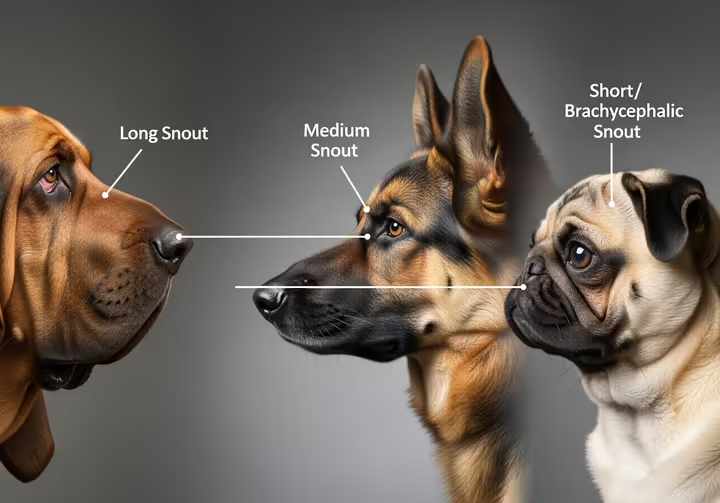
But don't get too hung up on breed. Recent genetic studies show that breed explains only about 9% of a dog's individual behavior. 61 A Bloodhound might have the hardware for sniffing, but its personality determines if it wants to use it.
Personality and History
A dog's personality and life experiences are much bigger factors. An anxious dog might be more sensitive to strong smells than a laid-back one. 29 Bad memories can also create powerful aversions. A dog rescued from a bad situation might hate a smell that another dog doesn't even notice. 10
Just Watch Your Dog
So what's the takeaway? There's no one-size-fits-all list of smells. The real expert on your dog... is your dog.
Pay attention to their body language. A sneeze, a lip lick, turning their head away, leaving the room, they're all telling you something. They'll let you know what they think, you just have to learn how to listen.
Works cited
- Dog sense of smell - Wikipedia, https://en.wikipedia.org/wiki/Dog_sense_of_smell
- How Powerful Is a Dog's Nose? - Phoenix Veterinary Center, https://phoenixvetcenter.com/blog/214731-how-powerful-is-a-dogs-nose
- 8 Dog Nose Facts You Probably Didn't Know - PetMD, https://www.petmd.com/dog/behavior/5-dog-nose-facts-you-probably-didnt-know
- A nose 1,000 times better than ours | UAF news and information, https://www.uaf.edu/news/a-nose-1000-times-better-than-ours.php
- The Olfactory Bulb in Companion Animals—Anatomy, Physiology, and Clinical Importance, https://pmc.ncbi.nlm.nih.gov/articles/PMC10216273/
- When the Nose Doesn't Know: Canine Olfactory Function ... - Frontiers, https://www.frontiersin.org/journals/veterinary-science/articles/10.3389/fvets.2018.00056/full
- What Scents Do Dogs Hate? - Happy Wax®, https://happywax.com/blogs/from-the-blog/what-scents-do-dogs-hate
- The science of sniffs: disease smelling dogs - Understanding Animal Research, https://www.understandinganimalresearch.org.uk/news/the-science-of-sniffs-disease-smelling-dogs
- Canine Olfaction: Physiology, Behavior, and Possibilities for Practical Applications - PMC, https://pmc.ncbi.nlm.nih.gov/articles/PMC8388720/
- Smelling more or less: Investigating the olfactory experience of the domestic dog - Barnard Psychology, https://psychology.barnard.edu/sites/default/files/inline-files/Smelling%20more%20or%20less.pdf
- Olfaction in the canine cognitive and emotional processes : From behavioral and neural viewpoints to measurement possibilities, https://research.aalto.fi/files/134460404/Olfaction_in_the_canine_cognitive_and_emotional_processes.pdf
- MRI Features of the Vomeronasal Organ in Dogs (Canis Familiaris) - Frontiers, https://www.frontiersin.org/journals/veterinary-science/articles/10.3389/fvets.2020.00159/full
- Vomeronasal organ - Wikipedia, https://en.wikipedia.org/wiki/Vomeronasal_organ
- Sensing Dog Brain Reactions to Smell by AI Speckle Pattern Analysis - PMC, https://pmc.ncbi.nlm.nih.gov/articles/PMC12162165/
- The dog vomeronasal organ: a review - Dog behavior, https://dogbehavior.it/dogbehavior/article/view/27
- Do Dogs "See" Smell? - Hobart and William Smith Colleges, https://www.hws.edu/news/2022/do-dogs-see-smell.aspx
- How Dogs “See” Smells | Psychology Today, https://www.psychologytoday.com/us/blog/your-internet-brain/202210/how-dogs-see-smells
- Sensory Overload in Dogs - Wag!, https://wagwalking.com/condition/sensory-overload
- How To Calm an Overstimulated Dog [Top Calming Suggestions] - Holistapet, https://www.holistapet.com/blogs/dog-care/how-to-calm-an-overstimulated-dog
- Overstimulated Dogs: Signs, Causes and Supportive Strategies | Honest Paws, https://www.honestpaws.com/blogs/health/dog-overstimulated
- Do dogs experience sensory overload like we do? - Fitdog, https://www.fitdog.com/blog/sensory-overload/
- Capsaicin - Wikipedia, https://en.wikipedia.org/wiki/Capsaicin
- Mechanisms underlying capsaicin effects in canine coronary artery - PubMed Central, https://pmc.ncbi.nlm.nih.gov/articles/PMC4200052/
- Chemical Burns in Dogs - Symptoms, Causes, Diagnosis, Treatment ..., https://wagwalking.com/condition/chemical-burns
- www.petmd.com, https://www.petmd.com/poisoning/cleaning-products-that-harm-pets#:~:text=Some%20common%20ingredients%20that%20are,ingested%2C%20inhaled%2C%20contact).
- Common Cleaning Products That Can Harm Your Pets - PetMD, https://www.petmd.com/poisoning/cleaning-products-that-harm-pets
- Keep your pets safe from toxic cleaning products - BC SPCA, https://spca.bc.ca/news/toxic-cleaning-products/
- Animal behaviour - Instinctive, Learning, Adaptation | Britannica, https://www.britannica.com/science/animal-behavior/Instinctive-learning
- The Smell of Trouble: Understanding Scent Triggers in Dog ..., https://www.dwdogtraining.com/near-me/scent-and-dog-aggression/
- how do animals with heightened sense of smell tolerate odors that humans find disgusting? : r/NoStupidQuestions - Reddit, https://www.reddit.com/r/NoStupidQuestions/comments/1m4itd/how_do_animals_with_heightened_sense_of_smell/
- 8 Smells That Dogs Love That May Surprise You – Dogster, https://www.dogster.com/lifestyle/smells-dogs-love
- (PDF) Canine Smell Preferences—Do Dogs Have Their Favorite ..., https://www.researchgate.net/publication/361212497_Canine_Smell_Preferences-Do_Dogs_Have_Their_Favorite_Scents
- What Smells Do Dogs Hate? - Canidae Pet Food, https://canidae.com/blog/five-smells-that-dogs-dont-like
- What Smells Do Dogs Hate? | Top 10 Scents - PetDoors.com, https://www.petdoors.com/blogs/dog/what-smells-do-dogs-hate
- What Smells Do Dogs Hate? Avoid These at Home - Careers Collectiv, https://careerscollectiv.com/what-smells-do-dogs-hate-avoid-these-at-home/
- 10 Safe Scents for Dogs, and 8 Dangerous Ones - Lolahemp, https://lolahemp.com/blogs/dog-health/safe-scents-for-dogs
- Jalapeno Allergies in Dogs - Symptoms, Causes, Diagnosis, Treatment, Recovery, Management, Cost - Wag!, https://wagwalking.com/condition/jalapeno-allergies
- Scents to Keep Dogs Away: A Guide by Doodie Free — Doodie Free ..., https://www.doodiefreeyard.com/blog/scents-to-keep-dogs-away
- What Can I Spray to Keep My Dog from Peeing in the House? – The ..., https://thedogdoctors.co.uk/blogs/news/what-can-i-spray-to-keep-my-dog-from-peeing-in-the-house
- Are Fragrances Harmful to Dogs? A Deep Dive Into Fragrances in Pet Care Products, https://www.doglyness.com/blogs/news/can-fragrances-be-harmful-to-your-dog
- Why Dogs Don't Like Perfume – And Why We Should Listen, https://www.dotdotpet.com/de/blogs/top-tips/why-dogs-don-t-like-perfume-and-why-we-should-listen
- Mothballs - American College of Veterinary Pharmacists, https://vetmeds.org/pet-poison-control-list/mothballs/
- Toxicosis From Mothballs in Animals - Toxicology - Merck Veterinary Manual, https://www.merckvetmanual.com/toxicology/toxicoses-from-household-hazards/toxicosis-from-mothballs-in-animals
- Toxicosis From Mothballs in Animals - Toxicology - MSD Veterinary Manual, https://www.msdvetmanual.com/toxicology/toxicoses-from-household-hazards/toxicosis-from-mothballs-in-animals
- What Smells Do Dogs Hate? - Potty Buddy, https://pottybuddy.co/blogs/potty-buddy-blog/what-smells-do-dogs-hate
- Never Use Isopropyl (Rubbing) Alcohol On Your Dog - Dogs Naturally, https://www.dogsnaturallymagazine.com/isopropyl-alcohol-dangers-dogs/
- Essential Oil and Liquid Potpourri Poisoning in Dogs | VCA | VCA ..., https://vcahospitals.com/know-your-pet/essential-oil-and-liquid-potpourri-poisoning-in-dogs
- Know About the Risks of Essential Oils for Dogs - WebMD, https://www.webmd.com/pets/dogs/risks-of-essential-oils-for-dogs
- Dangers of essential oils | Pet Talk - Texas A&M College of Veterinary Medicine, https://vetmed.tamu.edu/news/pet-talk/could-your-pet-benefit-from-essential-oils/
- How Dogs Use Smell to Perceive the World | VCA Animal Hospitals, https://vcahospitals.com/know-your-pet/how-dogs-use-smell-to-perceive-the-world
- How Animals Communicate Via Pheromones - American Scientist, https://www.americanscientist.org/article/how-animals-communicate-via-pheromones
- Multisensory Enrichment for Shelter Dogs - IAABC FOUNDATION ..., https://journal.iaabcfoundation.org/multisensory-enrichment-for-shelter-dogs-2/
- Study Finds Dogs Love Certain Scents · Kinship, https://www.kinship.com/dog-lifestyle/dogs-favorite-scents
- Scent training : r/Dogtraining - Reddit, https://www.reddit.com/r/Dogtraining/comments/syqpeo/scent_training/
- Scent Training Your Dog | Zoetis Petcare, https://www.zoetispetcare.com/blog/article/scent-training-dog
- Effect of brachycephalic, mesaticephalic, and ... - AVMA Journals, https://avmajournals.avma.org/view/journals/ajvr/73/7/ajvr.73.7.946.pdf
- The Shape of the Nasal Cavity and Adaptations to Sniffing in the Dog (Canis familiaris) Compared to Other Domesticated Mammals: A Review Article - MDPI, https://www.mdpi.com/2076-2615/12/4/517
- Treatment for Brachycephalic Syndrome - Veterinary Medicine at ..., https://vetmed.illinois.edu/pet-health-columns/brachycephalic-syndrome-laser-assisted-turbinectomy/
- 13 Fun Facts About Your Dog's Sense of Smell - CareCredit, https://www.carecredit.com/well-u/pet-care/how-well-can-your-dog-smell/
- Can My Dog Smell Me From Far Away? - Rover.com, https://www.rover.com/blog/dogs-can-smell-youre-leaving-make-easier/
- Does a Dog's Breed Affect Their Behavior? | PetMD, https://www.petmd.com/dog/behavior/does-breed-affect-behavior
- Dog genetics suggest that behavior is more than just breed | Broad Institute, https://www.broadinstitute.org/news/dog-genetics-suggest-behavior-more-just-breed
- Individuality | Waltham Shine, https://shine.waltham.com/dogs/individuality